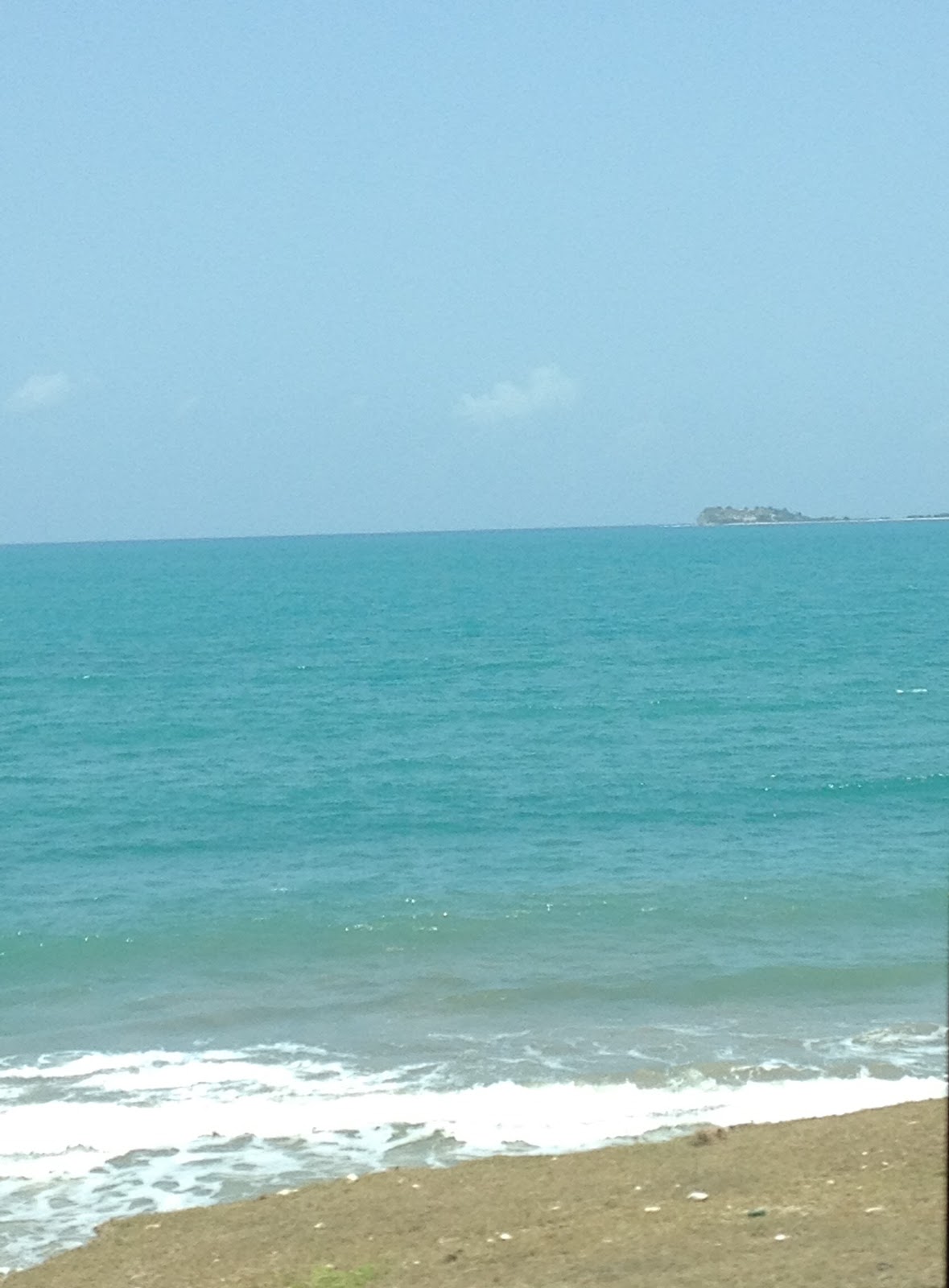
I’m reading about Haiti’s history, and I shake my head, trying to understand the problems the Haitians have faced for centuries. As a child, I remember hearing people referring to Haiti as “The Pearl of the Antilles.” A history where beauty and struggle collide. A country earlier renowned for the splendor of its landscape, Haiti has faced fierce exploitation of natural resources by successive foreign occupations and predatory dictatorships. Ongoing political instability has contributed to a sharp decline of agricultural productivity and widespread poverty. Then, the destruction caused by the 2010 earthquake in which 316,000 people are estimated to have died.

Upon my arrival to Haiti, while observing the reality the Haitians face daily, I realized how little I knew about this country and its real challenges. Embarked on a mission trip, along with nine other people, I felt embraced by the excitement of providing clothing and other supplies to children at Espwa, one of the largest orphanages in the world, located in the town of Les Cayes.
 I wanted to take part of that effort, even if my help seemed just like a grain of sand in an ocean of needs. But a serendipitous discovery happened to me. The Haitian people we spent time with, the children we played with, the women and men we visited with, they all enlightened my heart with humbleness and compassion, they helped me to reflect on the eventual weakness of materialism and vanity. When there’s no material objects, or luxury as a facade to others, that’s when the spirit of humanity shines, just like the summer sun.
Our arrival to Port-Au-Prince was thankfully uneventful. Transportation had been arranged, which was a tremendous help. A couple of vehicles waited for us. Our eyes were glued to the car windows, watching in awe during our five-hour ride from Port-Au-Prince to Les Cayes.

It was a heartfelt tour through devastation and struggle, for miles and miles. I’d be short on words if I tried to describe the scenes, and emotions. Perhaps some pictures can illustrate better what we witnessed.
Port-au-Prince has a population of about 1.2 million inhabitants and more than 2.5 to 3 million live in its metropolitan area, including the rapid growing slums on the hillsides above the city.
The National Palace collapsed during the earthquake. A once beautiful and glamourous building is now merely ruins. Fractured and frail--just like the country itself. Here is a couple of pictures of the building, before and after the earthquake.
The streets were crowded with people walking up and down narrow streets.
A lack of water supply and sanitation services were evident. Most of the population don’t have tap water. Women and children carry buckets full of water daily.
Port-au-Prince is about the size of Chicago. But it doesn't have a sewer system. It's one of the largest cities in the world without one. That's a huge problem, but never more so than during a time of cholera. Since cholera was introduced into Haiti in the last two years, more than a half-million people have gotten sick and at least 7,050 have died. Public health authorities say cholera will stay in the environment for a long time, because Haiti has the worst sanitation in this hemisphere.
Trash piles up in Haiti’s ravines, canals and streets until hurricanes and heavy rains come, sweeping huge amounts of trash and thousands of plastic bottles out to sea.
One intervention to combat this problem is through recycling centers and cash payouts for recyclables brought in by local Haitians. The centers’ founders hope that financial incentives will encourage people to reduce the amount of garbage tossed aside as well as providing jobs and income for struggling families.
Commerce in Haiti generally spills onto sidewalks, into streets and down avenues. Merchants establish wooden fruit and vegetable stands or take to selling wares from the ground or on foot.
The roads are bumpy and inconsistent, and the traffic is usually a chaotic flow of cars, trucks and motorcycles. The most vibrant vehicles in Haiti are by far the the tap taps–privately owned buses festooned with flags and coated from bumper to bumper with vivid designs, murals and bold slogans.
As the country and the world look to rebuild Haiti, it’s important to understand the demographic dynamics facing the country, Haiti’s very young age structure. The median age of the population is 20 years, and almost 70 percent of Haiti’s people are under age 30.
As we left Port-Au-Prince, going now into rural areas, the landscape changed to a more refreshing sightseeing. From dreadful scenes we went to some awesome, breathtaking views.
Most of us remained quiet at this time. Not sure if it was our tiredness and fatigue catching up with us, or if we were deeply immersed in our thoughts, trying to comprehend what was in front of us. In my case, I engaged in a profound reflection, as a social worker, as a human being, as a christian, and as a visitor. My anxiousness grew stronger as we were approaching our destination: Les Cayes, where a world of further learning, emotions and loving would await for us. We were about to spend one week in a Haitian community, meeting with hundreds of people--some of the most beautiful souls I've ever met. I will tell you why Haiti stole my heart.
My guest post on our mission trip to Haiti, "Day Three," has been published over at the Schweitzer United Methodist Church website:
http://haiti.schweitzerumc.org/?p=255
I inspected my small suitcase one more time. I had packed the most essential items for this particular trip. Unlike most of my recent vacation trips to the Caribbean, in this case I didn’t need to pack my hairdryer, or jewelry or an evening dress. That was the lightest traveling bag I’ve ever packed, considering I was going overseas. What made this trip so different from my prior ones? It was a mission trip. The Schweitzer United Methodist Church kindly let me join this project. We were a team of ten, our destination: Les Cayes, Haiti.
Photo source: http://haiti.schweitzerumc.org/
We arrived at Port Au Prince on June 29. There was a group of men playing music at the airport entrance, and selling their CDs. I thought they were playing reggae, but I learned later it was actually “Kompa” which it sounds like a mix between reggae and rap. The music made me feel welcomed.
The airport was small, and the humidity and heat were high, but it didn’t bother us. We were simply excited to know we have finally arrived to Haiti. Our energy level was at its peak.
 The immigration process was not as difficult as we expected. It helped that our coordinator Lori was quite familiar with the process, as she has completed this trip multiple times. Everything went fast and without a hassle. The immigration officers seem to have some respect for visitors on humanitarian missions. They seem to appreciate all the baggages we carried containing hundreds of clothing and hygiene supplies.
We dodged several “helpers” offering to carry our bags, as we had already made arrangements. A shuttle was waiting for us. It was comforting to feel the air conditioning again. It was much needed, as our real journey was just about to start.
Haiti, officially the Republic of Haiti, is a Caribbean country. It occupies the western, smaller portion of the island of Hispaniola, in the Greater Antillean archipelago, which it shares with the Dominican Republic.
Photo Source
Betsy was in her own world. A world we, on the outside, had little idea what was like for her on the inside, in her mind.
Aged in her nineties and diagnosed with end-stage dementia, Betsy’s daily routine in the nursing home was determined by what her caregivers anticipated her needs and wants may be on any given day.
Betsy had lost her ability to communicate. Her dementia had stolen her words, and even her ability to make eye contact. The staff tried to keep her comfortable while she rested in her bed or her customized wheelchair. Betsy would look into space, sometimes moving her hands randomly, for no apparent reason.
Betsy needed assistance with her meals. I observed the aides patiently feeding her, spoonful by spoonful, with pureed food.
I had visited with Betsy several times. I spoke to her, but she never responded, not even with her eyes. I tried sensory stimuli by applying lotion to her hands. I was uncertain if she enjoyed the stimulation, the gentile touching, at all. Perhaps I was simply an intruder in her private world.
My interest in Betsy grew stronger. I became more intrigued to bridge our two worlds.
Her family visited often. I was confident that Betsy could sense familiar voices and faces around her, and this would seem to please her. But again, Betsy’s cognitive impairment was so profound that she may have not known who was around. Nonetheless, the family was content with being there for her. They felt it was the right thing to do. And as their social worker, I assured them that was indeed the right thing to do!
“What is Betsy passionate about?” I asked Julie, Betsy’s daughter, during one of her visits.
“Mother played the piano.”
“I know she played the piano at church,” I recalled from my social services assessment. “Tell me more.”
“Mother’s interest in the piano comes from her childhood. My grandmother taught her to play the piano,” Julie said, proudly. “My grandmother loved classical music, and so Mother.”
“Did your Mom play the piano throughout her life?”
“That was her life!” Julie exclaimed. “She played at home, at church. She even taught piano lessons for a while.”
Julie had brought a radio to her mother’s room. It was normally tuned to a classical music station. I had no doubt Betsy liked to hear the music. But again, there was no indication of Betsy’s level of enjoyment other than her being calm.
I continued observing Betsy. I pondered Julie’s statement about her life-long interest in the piano. I realized that Betsy and I had at least one thing in common—we both loved classical music.
One day, as I was leafing through my CD collection, I came across my favorite classical music pianist: Chopin. Nocturnes were my preferred. As I mused how divine Chopin’s Nocturnes were to my ears, an idea flashed in my mind.
Betsy may like Chopin too.
I brought a CD player and my Chopin’s Nocturnes album to Betsy’s room. She lay in bed, looking aimlessly above her, expressionless, moving her hands randomly, as usual. I plugged in the CD player, and pressed the “play” button.
As the music started to fill the air, she slightly moved her head toward the music coming from the CD player. She seemed calmer, but still expressionless. Another idea came to my mind. I gently reached for Betsy’s hands. I gently started tapping my finger tips against hers in measured time to the piano notes.
Then something amazing happened.
Betsy’s fingers started dancing upon my hands as if she were playing the piano.
Excitement embraced me. I had somehow connected to Betsy in her world. I knew she was listening and enjoying the music. I knew she was feeling my touch. I knew her tactile memory had not vanished, despite her detrimental Alzheimer’s.
Betsy, the pianist and classical music lover, was still alive, vibrant. I felt like I uncovered a radiant Betsy from under the facade of an elderly incapacitated lady. I had nothing but respect and admiration for the loving mother, compassionate church fellow, and pianist which lay before me.
And from that day on, Betsy was no longer lost in her own world. We had discovered a language to reach to the treasures in her mind—the language of music.
I didn’t know I was about to ask the first really complex question in my life. I had little idea that the answer to my question would reveal to me, at a tender age of six or seven, a small window of a turbulent family past, a past that would haunt me for many years.
“Mami, why is Papá black?”
My innocent words rocked my Mami’s world, I sensed as her hazel eyes narrowed, glaring at me, with a mix of shock and disgust. I was puzzled. I didn’t mean to make Mami upset. I was simply noticing that my Papá’s skin was a dark complexion as compared to mine, which was the typical Hispanic olive tone, same as the rest of the family. Papá was darker, that was all, I was just curious.
Mami was definitely disturbed. She appeared startled, trying to figure out how to answer the question.
“He is black. But it doesn’t matter.”
Then I dared to ask an even more complex question.
“So, he is not my ‘real Papá’?”
My Mami’s face turned red. I knew now I was in trouble. I wished I had kept my mouth shut. But what would an innocent little girl know about the complicated world of the adults?
“A ‘real father’ is the one who raises you,” Mami said, distraught. “Your biological father abandoned you and your brothers.”
Mami’s words were like arrows shot into my heart. That was the first time I remember being hurt, deeply in my young heart. I knew that was the end of my questioning, but I had now many answers to find. Not that day, not that year, but someday.
My two brothers and I were raised by our grandmother Rosalba. She was the one we recognized as, and called, “Mommy” or “Mami” in Spanish. Her husband, Ulises, was our dear “Dad” or “Papá” as we called him.
That day, Mami went back to her household chores, and I was left in a labyrinth of my fragile mind. A new world was opening before me as I now realized that my Mom was not really my mother but my grandmother, and that my Dad was actually my step-grandfather. In the meantime, my mother, Oliva, lived in Bogotá, “the capital” and “big city” where she found a better job to help to support the family. My mother would visit us about three times a year, but our relationship was more like if she was our older sister. In fact, we addressed her by her first name.
Once, I asked my mother Oliva about my biological father. She showed me a picture. I observed it was a picture taken in a park. There was my mother in her twenties, sitting next to a man—my biological father—and a little boy in between them. The kid was supposed to be my brother Alex.
“Why did he abandon us?” I had to ask, I was still hurt.
“He found another woman,” my mother said without any hesitation.
Even if I never recalled anything about that man who gave life to my brothers and I, I sensed a void, and I kept asking the burning question. Why did he leave us? And I frequently came to the same conclusion.
He didn’t love us.
Papá was a great man. He worked hard to provide for the family. My brothers and I loved talking with him, and he seemed to always have interesting stories to tell. He took us fishing and swimming at the local rivers. He enjoyed taking us to the movies, especially if a western movie was playing, as those were his favorite genre. He taught us that “education was highly important,” even though he never completed grade school. He encouraged us to study and “be someone in life.” He taught me to read at home before I even went to first grade. He made the best rice pudding on earth.
Papá was wonderful to us, and I never again mentioned or asked about my biological father, as I felt it would be like betraying our Papá, the one who raised and provided for us. But the small window would sometimes open during windy times in which I started pondering again where my biological was, what he would look like, what would happen if he saw me now, grown up. Would he feel regret for abandoning us?
At age 21, I was a college student, and definitely an adult who needed to move out of the family home.
Living in my own apartment, I was now independent and free to search for my biological father, and find answers to my heart-aching question: Why did you abandon us? I started wondering if it was a quest, or an obsession. But I was determined to find him and confront him face to face.
I did my research which was not that complicated since my biological father had lived his entire life in the same town, and worked at the same place forever. I traveled three hours to the town he lived in. I located his workplace, a drug store, and I asked for him. An older man went to get him, and suddenly a man who looked just like my brother, Alex, showed up, looking at me with curiosity.
“Can I help you?” he asked.
“Are you Mr. Gallego?” I asked, hiding my nervousness.
“Yes. Why?”
“I’m Doris Gallego,” I exclaimed, and extended my hand to him. “Nice to meet you.”
His jaw dropped. He looked disturbed for a few seconds, and then he regained his composure.
“How did you get here?” He asked, blinking.
“Asking!” I laughed nervously.
“Well, can I invite you for a coffee?” he asked, motioning to the outside of the store. I don’t know if he wanted to avoid his embarrassment in front of his co-workers or if he wanted a private place where we could talk. Or, maybe, both.
We walked to a nearby cafeteria. We talked awhile. It felt awkward. I almost regretted the encounter. There, in front of me, all I saw was a stranger. There was no connection, as though I didn’t have his genes, or his last name. The air felt suffocating, and I wanted to leave, especially when he explained he left us because my mother was a very difficult person. I didn’t question any further. At that point, I cared less about him, or getting to know more about him. He was truly no one in my life, or my loved ones’ lives. I was finished with my quest.
A ‘real father” is who raises you, Mami’s words echoed in my mind. The man in front of me was not my father. Not even for a second.
I said good-bye, and we never talked or saw each other again. But amazingly, from that day on, the turbulence that had convulsed my mind and my head, completely vanished. I thought again of Papá and how much of a father he had been since my earliest memories.
I felt stupid. But I also laughed at the encounter with Mr. Gallego, at his expression when I said my name. I left that man behind in his town, and he was now out of my mind, or my worries. He was never part of my life, I realized, so I wasn’t, and hadn’t been grieving for any reason. Papá had filled that place, with love and care.
I wondered if my brothers and I broke Papá’s heart when we asked questions about his African-descendant features. He never said one word. He was a wise man and knew that it was merely children’s observations and curiosity. We never cared about skin color or matters of ethnicity, we were not raised with such preconceptions. Papá continued giving his unconditional love. Mami passed away almost twenty years ago. Papá has remained faithful to her, and to their memories. I’m thankful for having Papá with us. He is now facing health challenges. My brothers and I make sure to visit and talk with him often, and to let him know how much we love him.
This morning, I woke up knowing I had to make an important phone call. I dialed a number I have saved on my contacts.
“Hello?”
“Hi, Papá!”
“Oh, hi Mija!” That’s a slang for “mi hija” which means, “my daughter,” a common expression in Spanish. “God bless you” He never fails to give me his blessings every time we talk. That’s part of our Hispanic culture.
“Thank you, Papá. Happy Father’s Day!”
Photo source
Mr. Lewis was one of the finest patients I’ve ever had. Polite, well-spoken, always a gentleman. He lived alone in a small apartment at a retirement community. Since his wife passed away, he was more involved in group activities. He loved reading and watching the news. But his motivation and strength to do things, or even to get out of his apartment, decreased significantly since he started to battle brain cancer several months ago.
His illness had progressed to the point that the doctor had recommended end-of-life measures. Mr. Lewis cognition hadn’t been affected by his cancer, and he seemed aware enough of his poor prognosis that he agreed to sign up for hospice services.
I was Mr. Lewis’ hospice social worker.
I looked forward to my visits with Mr. Lewis. I loved being in his cozy, impeccable apartment. His conversations were delightful, rich in details of his successful career as a financial adviser, and full of happy stories about his wife and son. He and his wife travelled to several countries once they retired. His son was a teacher, and lived just a few miles from Mr. Lewis’ apartment, so father and son visited often.
During a visit, I noticed Mr. Lewis was unusually quiet. His eyes lacked the brightness he normally sparked. His dull expression alarmed me.
“Mr. Lewis...” I drew close to him. “What’s wrong?”
“I lost ‘Buddy.’” He said, with lifeless words.
I’d recently learned that his beloved dog and companion of sixteen years had been very ill, and Mr. Lewis’ son had taken the pet to his home.
“He had to be put to sleep.” Mr. Lewis said in a broken voice.
I encouraged him to talk about ‘Buddy’ and after shedding some tears, he showed me pictures of his loving pet, and told me a couple of humorous stories involving Buddy misbehaving.
I admired Mr. Lewis strength to deal with so many losses. His wife, his health and now his dog.
A few days after that, as I was heading back to see Mr. Lewis, I stopped by the Hallmark store and got a stuffed animal. I hoped it might resemble ‘Buddy.’
“I have something for you, Mr. Lewis.” I grabbed my bag and retrieved the gift.
Mr. Lewis’ eyes brightened and his lips curved into a gleeful smile.
“That’s so thoughtful of you. Thank you!” He placed the new ‘Buddy’ next to him, on the couch. Then he engaged in a conversation about his recent palliative radiation treatments.
I noticed there was no mention of ‘Buddy’ in the conversation. I pondered whether my gift would be of any help.
That new ‘Buddy’ looks too inert for Mr. Lewis, I thought as I glanced at the stuffed animal.
That week I thought of Mr. Lewis and worried about him feeling lonesome. In his condition, I knew the idea of getting another dog was a chore that Mr. Lewis was not in any capacity to assume.
Then another thought crossed my mind.
A fish!
I rushed to the pet store, and purchased a Betta fish, fish food, a large glass bowl and a few accessories.
Mr. Lewis will have a live pet, an easy to take care of, and a source of relaxation, I thought.
Mr. Lewis’ eyes lit up like a sun as I produced the gift. A broad smile blossomed on his face. The entire visit was about settling ‘Little buddy’ as he called his new pet. We read the care instructions and prepared every detail meticulously. The bowl sparkled with life as the new pet fish started to bounce up and down, gracefully waiving its shiny red fins and tail.
“‘Little buddy’ is greeting us,” I said, pointing at the small creature.
“He sure is!” Mr. Lewis exclaimed. His eyes shone with an expression of joy.
Photo Source
P.S. Thanks to Patti over at The New Sixty for reminding me of this story as I read her lovely post The Perfect Pet. Something quite interesting she mentions is: "It is a known fact that watching fish will calm you and lower your blood pressure."
“Oh my God!” The charge nurse shook her head, and sighed. I heard her, as I stood by her desk, looking for a medical chart.
“What’s wrong?” I asked.
“The new admit...” Her face had an unusual, worrisome expression. “Have you met him?”
“No, not yet. I’m actually looking for his chart.”
“Please, go and see him.” She looked distraught. “I’ve never had a patient that looked like that. It’s just so sad.”
“What?” I frowned, with no clue of what was upsetting her so much. I thought I should better go and meet Mr. Johnson, the new resident who had just been admitted.
I knocked at the door. “Come on in,” I heard a deep voice reply from inside the room. I opened the door and walked in. Mr. Johnson was sitting on the recliner.
I understood immediately why the nurse was disturbed. Mr. Johnson’s appearance was shocking. Nothing like I had seen in a nursing home before.
Mr. Johnson had suffered a long fight with cancer, and it had won, now metastasized, with his face showing the battle scars. He had just undergone a surgery that required part of his skull and face being removed. Some kind of skin implant was done to cover the enormous wound.
I was prepared to see something heartbreaking, but not to this extent. His appearance was something only Hollywood would produce, a picture from a scary movie. It was certainly disturbing.
Fortunately, I remained calm, and treated him like any other of my residents. I welcomed him, and offered to accommodate for him anything that was feasible to meet his needs.
He was polite, yet his words carried a hint of authority.
He wasn’t looking for sympathy.
At that moment, I started looking at Mr. Johnson from a different perspective, his appearance being no longer a distraction. I saw a proud man in his late eighties, not ready to give up with his long battle against cancer.
In the following days, the staff complained that Mr. Johnson was “demanding,” and that he would not comply with some of the “standard” care protocols.
“He doesn’t listen, he just does what he wants to do,” an aide said.
“He wants to go home but the hospital told him he had to go to a rehab facility,” a therapist commented.
“Mr. Johnson is really upset,” a nurse voiced to me. “He went to the dining room for breakfast and he got mad at people staring at him.”
My lips drew taut. I knew my resident was facing not just the battle against his illness, but also the shun of others who failed to realize that the scars he visibly bore in his losing fight against the cancer hurt his pride.
I visited Mr. Johnson in his room that afternoon. He laid in his bed. He asked me to sit at his bedside. I did, and we began a light, trivial conversation. Then he seemed comfortable enough to start telling me about his personal life.
He spent a great deal of time talking about his career in the military. The conversation turned into a fascinating and meaningful discourse. The spirit of a courageous officer emerged there in front of me as he continued his narration of his 26 years in the military. A brave American soldier shone through his anecdotes of his WWll mission as a gunner in a military aircraft.
Photo source
I no longer looked at a patient with a deformed facial appearance, with protuberant freshly and bloody scars. What was in front of me was a hero. A hero from WWII and a hero here and present, struggling to be released from yet another battle, for freedom.
Mr. Johnson talked about his illness, and how he had gone against the odds to survive, even though his battle had left him with quite an unpleasant appearance.
“I’m fully aware of how I look, and won’t be intimidated because of that. That’s why I went to the dining room this morning, but it was overwhelming to see all those people staring at me, like if I looked creepy.” Mr. Johnson spoke in a broken voice and his eyes welled in tears.
I held his hand, and said nothing. I felt a knot in my throat.
“You see? I want to be where I belong... home.” Mr. Johnson said with soft words. “I want to go home.”
“Mr. Johnson, you’re a fighter, and an inspiration to anyone who will know you.”
A week later, I went to Mr. Johnson’s room to say good-bye. He was being discharged to his home that day. Home health services and other medical arrangements were made.
“You’re an angel. Thank you,” Mr. Johnson said, and drew close to me, kissing me on my cheek.
I hugged him, fighting away tears.
I heard that Mr. Johnson died two weeks after his discharge. His body had given up, but his spirit remained, especially among those he touched with his wisdom and courage.
"Even against the greatest of odds, there is something in the human spirit - a magic blend of skill, faith, and valor - that can lift men from certain defeat to incredible victory." - Walter Lord (1917 - 2002)


 I wanted to take part of that effort, even if my help seemed just like a grain of sand in an ocean of needs. But a serendipitous discovery happened to me. The Haitian people we spent time with, the children we played with, the women and men we visited with, they all enlightened my heart with humbleness and compassion, they helped me to reflect on the eventual weakness of materialism and vanity. When there’s no material objects, or luxury as a facade to others, that’s when the spirit of humanity shines, just like the summer sun.