Powered By Blogger

Pages

Saturday, July 17, 2010

Silly me!


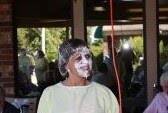
“Throw the pie in my face” I goaded Mr Smith, one of the nursing home residents.   

“I can’t” he replied. Mr. Smith looked at me with a caring look, through his big blue eyes which always cast an innocent sparkle. 

“It’s OK, Mr Smith. Today you’re supposed to throw a pie in my face; please!”, I commanded.  

Mr. Smith grinned, and mustering all the courage he could, he cocked his right arm and, without hesitation, threw the pie in my face. The gentle impact I expected turned out to be a powerful slap. 

I lost my sight for several seconds as my eyes were completely covered with whipped cream. I heard voices and laughter, all combined with the upbeat music playing:  “Heeeeey Macarena ...AAAhAA! Dale a tu cuerpo alegria Macarena... When I dance they call me Macarena’”   

Mr. Smith was laughing. The residents were laughing.  

How hilarious to see the social worker with her face messed up, with her nostrils plugged with thick cream! 

And I laughed too.  

Pie throwing was part of the activities for that day. “Do you want to volunteer?” the activities coordinator had asked me early that morning.  I felt awkward at first. 

“Me? It will be messy and embarrassing,” I replied.  

But my thoughts switched quickly to my residents. They would be outdoors, enjoying not just the nice weather but the fun activities scheduled as well.  

Why shouldn’t I be part of it?  Why wouldn’t I put aside my personal appearance to humor the residents and just relax and have fun as well?  

Silly me! I chided myself. 

“Sure!” I answered.   

And I was glad.  

I had the opportunity of letting Mr. Smith have a blast. I made him laugh.  

I had met Mr. Smith a few years ago. Then, he was a very ill, bed-bound and quiet man. A person who didn’t  normally smile. He was a kind gentleman, but not a man with much to look forward to, at least in his mind.  

Now, a couple of years later, he is a different man. He actively participates in social gatherings and outings. He wears a smile on his face, and openly laughs at humorous moments. 

He is a man with the strength to slap a pie in my face.  

That night at home, I reflected on the event. I was pleased with the experience, yet it bothered me that I hesitated when initially invited to be “a pie target”

I asked myself:  am I limiting fun and joyful moments in my life lately because having fun wasn’t always practical? Am I avoiding putting myself in embarrassing circumstances to the extent that I am missing amusing time with loved ones and the people I care for? 
I hoped not. 

I looked back in time and recalled a few times when I decided to be brave and venture into daring events. One time I remember wearing a Halloween costume in the nursing home, and then later around the neighborhood with my children.  


On another day, I ended up dancing on a stage in one of the music shows in Branson, along with other volunteers from the audience.  

Embarrassing moments? No. Not at all. 
Fun memories? Certainly. 

Thursday, July 8, 2010

Born on the Fourth of July


“Happy birthday, Ernie!” we cheerfully exclaimed. My husband, stepson and I had taken Ernie out to dinner for his birthday.  

Fourth of July. 

A double celebration: our glorious Independence Day in the United States of America. And my son’s birthday.  Ernie was celebrating his 21st birthday.  

His own independence, I mused. 

I love my son with all my heart. I have been thinking about Ernie’s life lately. I thought back to before his birth and reflected forward through his life to this date, where he now sat before me as a 21 year old. 
Ernie was a wanted child.  Bringing him into this world was well thought out.  Upon his arrival, he immediately brought happiness to me and his father, and to the rest of the family. He was always loved by everyone around him. He was a cute, charming, and smart child.  

 While Ernie traveled his path of growing up, I’ve been with him during his “green pastures” and “still waters” but I have also been with him as he walked through “the valley of shadows.” 

I could dedicate a complete blog to our memoir. Ernie might want to do it some day. Not me. At least not at this time. 

One of the saddest events in Ernie’s life was the passing of his father when Ernie was just 12. And the most critical time I recall was when Ernie was 16. At this age he became quite rebellious, angry, and hateful.   

“Give me a hug,” I asked once, as hugging was a normal event between us, at least it used to be. “Nah,” he replied. 

“But why, Ernie?” I was in shock. 

“I am not a huggy person,” he said, thoughtlessly, walking away, like a bird trying to fly out of the nest.  
What happened to my Ernie? I pondered, with tears in my eyes. I had no answer. I found no explanation. Perhaps I didn’t want an explanation.  

Anne Lamott, one of my favorite writers, published in 2006 “My son, the Stranger” an interesting magazine article about a similar experience she went through with her son. That’s how I looked at Ernie, a stranger.  

Ernie moved out at age 17. The bird had fled the nest, leaving my broken heart in the roost, alone. I didn’t anticipate the anguish I initially experienced when he left.  What a loneliness I felt when I looked into his empty room.  A feeling of desolation enveloped our home. Devastating quietness. I felt as if I were drowning.   

I don’t know how he felt, but we both survived. 

A few years later, Ernie returned home. We were happily reunited, but faced the tensions of readjusting to living with one another under one roof again, full time. Ernie struggled for freedom he had while living on his own, while I tried to enforce family rules. Plus a new challenge awaited us both:  a blended family, as I had recently remarried.  

“One day at a time” is what I always tell my nursing home residents when they lament their losses. That’s what I often remind myself during difficult times.  

In the meantime, I showed Ernie support and unconditional love. And most importantly, I lifted my prayers to our Lord every single day, asking for guidance and protection for Ernie.  

And God answered my prayers. 

In the last year, Ernie has remarkably changed. Positive changes. His heart has turned back to me as his mother, and as his friend. We have shared tears and secrets. He enjoys our conversations. I love listening to his tales, his aspirations, about his college journey, and work challenges. I enjoy learning about his fights against his evils, and how he has overcome the battles. His inner battles. 

Ernie knows how precious he is to me. He is no longer reluctant at expressing compliments, or at telling me he loves me. He listens to my stories about work. He enjoys reading my blog, and counting my followers. And he hugs me every day.   

Ernie is huggy after all, I muse, with a smile on my face.   

Just as the Parable of the Prodigal Son, I celebrate my Ernie’s return: “Quick! Bring the best robe and put it on him. Put a ring on his finger and sandals on his feet. Bring the fattened calf and kill it. Let's have a feast and celebrate. For this son of mine was dead and is alive again; he was lost and is found.” 

P.S. Happy birthday, Ernie. I hope you like reading this post. I love you, dear son.

Monday, June 28, 2010

My encounter with Andy


“Who is he?” I asked, pointing toward a man waiting for the start of the Memory Walk.  Next to him was a woman who wanted her picture taken with him. Rob looked at me, doubting.  “You don’t know who he is?” Rob was one of coordinators of the event, and a good friend of mine.  

“No, I don’t know him,” I stated.  

“That’s Andy Williams!” 

My eyes opened widely, and my jaw dropped.  

“Andy Williams?”  

“Yes, Andy Williams!” 

I couldn’t hide my surprise. I was a big fan of Andy Williams. I loved his music. “Moon River” -- what a romantic song--  “Music to Watch The Girls Go By” --such a cheerful song, and one of my favorites ever.  I could hear his songs swirling in my head as I looked at him, out of his element and in casual shorts, preparing to walk. 

I had attended a couple of his shows, and I had always hoped to shake his hand. Unfortunately, unlike many other celebrities in Branson, Missouri, Mr. Williams 
doesn’t normally come down from the stage to greet his audience.  

There I was, standing about 20 feet from him. He looked older and more slender than on his bigger-than-life pictures on billboards and in his brochures. But I could care less about his looks. His voice and talent was all I cared about.   

“Rob, I have to have a picture with him, but I didn’t bring my camera.” I was desperate. I felt just like a teenager in a music concert for first time. I had to improvise something fast before my chance would vanish and he would walk away, as he was supposed to in the Alzheimer's walk.  

“I’ll  take the picture with my camera” Rob offered.  What a relief to hear. I accepted.  

We rushed to get close to Andy. “May I take a picture with you?” I asked. “Sure!” he answered, with a smile. He put his arm around my shoulders, and held me close to him. I could feel his energy, his strength. 

What an emotional moment.  

I thanked him, and walked away, as I didn’t want him to feel smothered. Andy was there to take part of the annual Memory Walk, promoted by the Alzheimer’s Association. I assumed he wanted to enjoy the walk rather that being chased by fans. 

A week later, Rob sent me the picture. I was thrilled. But another idea sparked in my mind. I mailed the picture to Andy’s theater with a note, asking if he would please sign it. He did, and returned it to me, signed: “To Doris. Best wishes.” 

I kept the picture as one of the most precious mementos in my life. I found a special place in my office to display it. I showed no humbleness when visitors and clients would ask: “Is that Andy Williams?” “Yes!”, I would answer with a grin in my face, and would proceed to tell them about my unexpected meeting with Andy at the 2006 Memory Walk. As anyone could guess, I have enjoyed every time someone says, “Wow, that’s neat!” or exclaims,  “That’s cool!”.   

I followed Andy’s celebrity news closely. I learned that Andy was publishing his memoirs. The excitement embraced me when I heard that he was having a book signing event. 
This time I am going be prepared, I mused. 
I had my camera with video recorder ready. Claire -my stepdaughter- was coming with me, and I instructed her on every possible detail for picture taking and video recording. We arrived early to the store where the event was to take place. I was the fifth person in line.  

My heart pounded when I heard that Andy had arrived.  

I looked at Andy with a keen eye. I noticed he had visibly aged. He had lost weight. He seemed unmotivated. His face wore a flat, unemotional expression.  


I sensed that he was not the Andy I had met four years back. 

When it was my turn, he signed my book, and quickly looked for the next person in line. Andy’s staff asked me to move on. As in a disobedient attitude, I turned back to Andy and asked him if he could write “To Doris” on the book. Andy looked at me with clear annoyance. “I’m just signing my name,” he said, dismissing me.  


I was shocked. Certainly disappointed. 


I looked at Claire and waited for her to take a picture. I nervously smiled. Just for the picture. 


And we walked away. 

As we were leaving, I felt like my pride dragged on the floor, being torn in pieces along the shiny tiles. No one would bother to clean up the remains. 

When I got home, I told my husband, family and friends about my unpleasant experience.  The next day, I removed Andy’s picture from my office. I was no longer his fan. I didn't appreciate Andy’s behavior. I cared nothing about his book.  
Writers ought to be excited about signing their books. 
I couldn’t believe that the first book signing I had attended would turn into a sour memory. 

Andy was not a writer after all, I  thought, consoling myself. 
Months later, I found myself musing about Andy and the book signing. I sat deep in thought and dispassionate consideration of the event. I started to think of Andy as a person rather than a celebrity. 


I recalled that Andy was in his 80’s. I presumed he had health challenges to face. Aging can be a burden. He might have had a lot of stress at that time. Being a celebrity and a businessman would obviously impart that worry, and pressure would take the better of him on some days. Who knows what family issues may have arisen that week, or that day. Andy may have been lonely or depressed, even if surrounded by many people.  

After all, we, the fans, are all but strangers to him. 

My heart started to feel empathetic with whatever his life challenges may have been that day, or may be by now. I have come to realize that I had the luck of seeing him face to face twice in my life. My perception of his personality can’t deny his well honed talents. I still love his music. I certainly admire and respect him.

I searched until I found the picture I had removed from my office. I dusted it off.  

The dust of my own arrogance, I compared. 

I brought the picture back to my office, and with it, the gleeful feelings when I first met Andy.  The happy, philanthropic and vibrant Andy.  The living legend. 


Friday, June 18, 2010

People's essence


“It’s interesting to sit here, and watch the people,” our curious friend, Don, commented wearing a grin on his face. “That’s exactly what I was thinking,” I replied, amused. It was a family day at a theme park. My husband, our children and I were having a blast.  Our friend Don and his wife were with us. While our children were enjoying some of the park rides, we were sitting comfortably, observing the crowd of visitors walking around. 

People of all ages, sizes, and looks were at the park that day --Energetic kids, talking loudly in high pitch voices, demanding to go on rides and shouting for foods of all sorts; overdressed elderly women, walking slowly as though they were trying to catch up with the years gone by; vibrant and good looking teenage boys and girls, some of them indulging in romantic hugging and kissing, while the others were boastfully sharing their latest romantic tales.  

A young man caught my interest. He was sitting in a customized wheelchair, being assisted by a man who appeared to be his father. My unduly inquisitive mind tried to determine whether the young man had cerebral palsy or a prior brain injury. He was drinking from a sippy cup held by his caregiver. Quite a nurturing image, I thought. 

I immersed myself in the people’s worlds, as discreetly as possible for fear of being taken as an impertinent watcher.  Clothing color, accessories style, body movements, facial gestures, mannerisms, food preferences, and the choice of jewelry a person chose to wear that day, all subtleties not normally considered in detail, were my delight. It’s certainly amazing the multitude of niceties that one’s eye can capture within just a few minutes.  

My observant eye.  

Yet my inquisitive mind switched to a more interesting quiz. How much can it be inferred about people based only from their personal objects?   


A lot. 

Isn’t that an important part of the forensic sciences after all? 

While musing on the subject, I recalled a quite particular experience. Last year, I decided to volunteer at the church resale shop, a few hours a month. I thought it would be a noble and enjoyable time since I like sewing, ironing and making clothing look as neat and presentable as possible --My mother taught me to be meticulous with my clothes: no wrinkles, no holes, no stains were to be spotted.   

While unpacking and putting up donated clothes, my curiosity didn’t have to wait to find objects of interest: the donors themselves. I started to wonder about the people who had owned and enjoyed -or perhaps hated- these clothes. 

And the game started. 

I tried to visualize the middle- aged woman who might have donated the classy black and white, two-piece dress, or the young girl that may have given away the tank top that no longer fit her. 

But the game turned odd when I held up an extra-large pair of blue jeans. They had evidently been worn multiple times. It came to my mind that the jeans might have belonged to a young man. Strangely, I had the feeling he was anxious, and somewhat sad. I didn’t know why I was getting that feeling. I disliked what I was thinking, and set the jeans aside, attempting to focus on something else.  

Unsuccessfully.  

An unexpected impulse drew me to check the jean’s pants pockets. I did. A surprising discovery. 

There was a small white pill in one of the pockets. I examined it carefully. I was unable to identify the pill as its markings were worn off.  As a healthcare worker, I suspected it was a narcotic, most likely a pain killer.     

I discarded the pill immediately, and closed my wandering mind to reflect about people’s essence.  Their spirit, their soul.  

I concluded that whether I was right or wrong in my visualizations about the clothing donors, I had no doubt that we are leaving a print --visible or not-- in everything and everybody around us, or part of us. 

Our essence.  

Nonetheless, may we ask ourselves:  what kind of essence or spirit are we projecting today, or leaving behind for another to find? 


Tuesday, June 8, 2010

The language of love


I turned my head away, and discreetly wiped the tears from my eyes.  It’s very rare for me to become tearful in front of my residents or their family members. As a professional, I feel that if I can’t control my emotions, I won’t be able to give what my clients need at their time of crisis, my support, and rational advice. Crying with the clients can put a social worker at risk of overstepping her boundaries into the grieving that the clients need guidance surviving through. 
That was a tough day at the nursing home. An urgent meeting with one of my residents, Mrs D, and her daughter was about to start. It was an important meeting with the professionals of the different disciplines -interdisciplinary team- to discuss Mrs D’s care plan. There were critical decisions to make. Mrs D was unable to speak due to prior stroke. She could only communicate using a board with pictures and symbols.
After assessing her current life situation, and addressing her medical issues, the meeting coordinator asked Mrs D: “Let us know your wishes”.  Mrs D looked sad. She was confined to a wheel chair, and a feeding tube provided her only sustenance. We all knew she hated the feeding tube. 

She had been a very active and independent woman, and had always made clear to her family that she wouldn’t want any artificial means to prolong her life. Mrs D had actually signed her living will long time ago. Her end-of-life wishes were written in her Advance Directives. 
Mrs D looked at us, then looked at her daughter. Slowly, she lifted her hand, and pointed her index finger at the ceiling. It was very obvious. 
She was ready to go to heaven.
We all looked at her anxious daughter. She had been upset when she heard that her mother was not making any progress with therapy.
“She may be ready, but I’m not”, the daughter exclaimed. She drew close to her mother. “Mom, I know this is not how you want to live, but I am not ready to let you go”.  Mrs D’s daughter broke in tears. 
Mrs D looked upon her daughter with compassionate and maternal expression. She caressed her daughter’s hand as best she could with her stroke-impaired hand. Then she pointed to her board. She looked at the pictures. I wasn’t sure if she was looking for the appropriate picture, or if she was just thinking. She slowly moved her daughter’s hand she held to one of the pictures, and placed her finger on it. Only one. 
It was a heart. 
She then pointed her daughter’s hand to her own heart. It was very clear. 

I love you, was the message.
“I love you too, Mom”, Mrs D and her daughter embraced in an infinite hug I’ve never witnessed before. The room already silent, swelled with calm. Not one word was said. Everyone stood motionless. I couldn’t see the others’ faces as my eyes welled with tears. 
The meeting gently adjourned. We left the room with the certainty that we have witnessed the love of a daughter and her dying mother, my job to help bridge. This was the mother and daughter journey that they were to go through together, not guided by an advance directive or a written document.  

Only by their love, their love for each other. 

Friday, May 28, 2010

My left side


“Kick the board,” my instructor demanded. A side kick. What I had seen in Kung Fu movies was now my real life reality. An exciting, yet frightening reality.  

“You can do it!”, my instructor, the Sensei shouted. I heard encouragement in his voice, but my own inner voice questioned, “What if I hurt my foot?” I would be embarrassed if I failed. There were too many people around, watching me. Their watchful eyes made me worry more about my performance, than my own personal success in executing the technique.  

I took a deep breath, and echoed the Sensei’s words in my mind: “You can do it!” I kicked the board, snapping it crisply. I felt empowered by hearing the snap and the crack of the board yielding to my bear foot. 

The exercise was part of my Tae Kwon Do practice a few years ago. I was testing for my green belt. The broken board on the floor was testament that I had passed. I was proud of myself. In my hesitation to risk splintering my foot, and hearing the Sensei’s encouragement,  I learned that my potential is greater than what I would have normally believed. I believe we all often under estimate our capacities and strengths.  

As a young girl, I wasn’t very motivated in participating in physical activities and cared less about engaging in competitive sports. I occasionally played basketball, but I was usually afraid of getting hurt. 

Training in martial arts revealed to me how wrong I was.  

I practiced Judo while in college. I did so only because a sport unit was a degree 
requirement. I elected a martial art course more out of curiosity than for any serious 
commitment or interest.  
As a new Judoka I was shy, fearful. Again, I was afraid of getting hurt. 
  
My first surprise was to learn that Judo means “gentle way” or “flexible way”   

Who would associate martial arts with gentleness?  That wasn’t what I had seen in the movies, or what I had heard from people.  

My Sensei taught his students a very interesting concept: A Martial Art is not just a sport; it is also a philosophy.  Successfully practicing a martial art demands self-discipline and respect for others. Advancement in this practice requires self-confidence and self-control. Balance of the body and mind.  After that comes the learning of techniques.

There was one particular discovery in my martial arts journey.  It happened when practicing Judo. It seems that students tend to favor one side of their body than the other, and that side is typically associated whether they are right or left-handed. In fact, most of the students are right-handed. I am right-handed but my Sensei noticed a strength that only an instructor could identify: he saw that the left side of my body, which I’d considered my “weak side”, was actually as powerful as my right side.  And I became quite successful with left-handed techniques.
 “A good Judoka will have both right and left-handed throws in their arsenal,” another Sensei had said.
   
My martial arts experience has been very useful in my personal life. I am no longer 
afraid of getting hurt. I don’t want to be hurt, but I am not hesitant to strive for 
triumphs merely due to fear of being hurt. 

I’ve also learned that those we believed are our “weaknesses” may be only misconceptions, and can actually turn into strengths. 
Now, when it comes to challenges, I like to remember:   

I can break the board. 
I can use my left side.

Friday, May 21, 2010

Wisdom In My Apron Pocket


“Where’s my apron?” -my 8-year-old stepdaughter, Sydney, asked after the church meeting. I looked at her, pondering her question.
Early that morning, my two stepdaughters and I were to attend a ladies luncheon at our church. The theme was “Wisdom In My Apron Pocket.” Ladies were encouraged to wear their aprons. There would be an Apron Fashion Show.  

I had found a plain apron and on the day of the event I started to decorate it. I asked Sydney and her 12 year-old sister Claire if they wanted to help decorating my apron. I thought it might be a fun activity for the three of us.  

And, it certainly was.  

Our minds connected in our singular world to decorate the apron. Creativity splashed out with ideas as our hands crafted what our minds envisioned. Vibrant colors and shapes, blending magically on the canvas of the plain apron. No doubt, we were having a great time.


I asked the girls if they would like to have their own aprons to wear at the luncheon, but the girls declined. “Do they think aprons are only for older ladies?”--I wondered. 

The idea of the apron was so unique. The church ladies couldn’t have come up with any better theme for the occasion. Viewing my apron was like going back in time to some of my most beautiful memories in life: time with my mother and grandmother. I still can picture them in my mind, wearing their own aprons while cooking our meals, taking care of our home, and even while bathing us. 
The apron revived memories of my mom and grandma sewing.  I felt as if I could hear the sewing machine churning as my grandma pedaled it, with a rhythm that synched with my heart beats of happiness, while I watched her create from a pile of cut cloth a new summer dress I would  wear on Sunday to church, and later to the park for a walk. 

Their aprons symbolized coziness, protection, modesty. There was always something in their pockets. I often hoped for them to dig in their apron pockets, and find one or two coins: my reward for behaving, and the key to the treats in the candy store down the street.  

I too had an apron. My grandma made one for me. I had worn it proudly. But I think I forgot about my apron in my pre-adolescent years. I can understand Claire and Sydney not wanting to wear aprons. Aprons are vintage fashion after all, aren’t they? 

But just as my memories had come to the present from the past, once my stepdaughters and I had finished decorating the apron, we all three became excited. We shared a feeling of pride and satisfaction, praising ourselves for our creation.  We had crafted little dresses and sewed on the apron.

They resembled the ones my mom and grandmother had sewn for me, those many years ago.  

The apron fashion show at the church was wonderful. A lot of beautiful and meaningful aprons were modeled and explained. A few aprons were given away as prizes. Claire won one. She put it on. I had mine on, too. 

So, when the event was over, and as we were leaving, I looked at Sydney.  I could see in here eyes that she was still wondering, “Where’s my apron?”  I took my apron off and knelt next to her.  I hung the apron over her neck and said,  “Sydney, this is your apron.”  She yelped,  “Yeah! Can I keep it?” with wide eyes and a grin. 

“Of course,” I said, "I made it for you.”