Powered By Blogger

Pages

Saturday, July 28, 2012

Haiti- The Pearl Of The Antilles (Part 2)


We finally arrived to Les Cayes, formerly Aux Cayes, a town and seaport in southwestern Haiti, with a population of approximately 46,000 people.  We turned onto a gravel road, and for a few minutes we struggled with the bumpy car swings until we entered Pwoje Espwa or “Hope Village.”  


There’s a gate, with a security guard. The first building we spotted on our left was the orphanage. Perched on a 125-acre property, this orphanage, the largest in the western hemisphere, houses over 600 kids. 


The kids receive education through high school, balanced meals, clothing, medical services, vocational training, recreation, and much of caring. 


                                                 Clinic


We were taken to the guest house, a safe and comfortable place for visitors. The soft breeze of the afternoon was as warm as the greetings and smiles from the Espaw residents. 


Throughout our week stay, we had the opportunity to tour the different buildings and projects in the Hope Village.  We contemplated the crops, the cattle and goats, as part of the productive projects implemented.  


It was unfortunate that we couldn't meet Fr. Marc, founder of Pwoje Espwa, who has spent fourteen years devoted to Haiti. Fr. Marc was gone on sabbatical. 

The orphanage has housing units, with home mothers assigned to care and supervise small groups of children.  It was summer, the kids were out of school, so they had plenty of time to run and play throughout the day.  One interesting fact is that even though they have been supplied with shoes, they preferred to run bear-footed.  It was cooler for them given the heat.  There was no air conditioning, so light clothing was favored. 
                                               Trash pick up activity with the kids


My first encounter with the children was a heartwarming experience.  I’ve never had so many children around me, blooming with smiles and hugs.  I loved their sweet little voices, speaking their Haitian creole.  I knew nothing of creole but after some memory struggle I was able to retrieve some of my high school French basics, and voilĂ ! the kids understood some of my broken French.  I loved how beautiful they pronounced my name. 


But the best was yet to come. The next day, we had a “shopping” activity with the little girls.  Our team had brought girl dresses that we displayed on tables and shared throughout the patio of the guesthouse.  Each girl could go around and pick up a dress of her preference, and hair bows and hair combs.  Initially, they seemed shy, but soon they were cheerful and smiley. 


Yet the real excitement for me started when one of the girls, Moustafa, started to touch my ponytail and asked me to let her comb my hair. I loosen my hair, and she started to comb it.  Suddenly, I found myself surrounded by a group of smiley girls, combing and braiding my hair. I was in awe. 
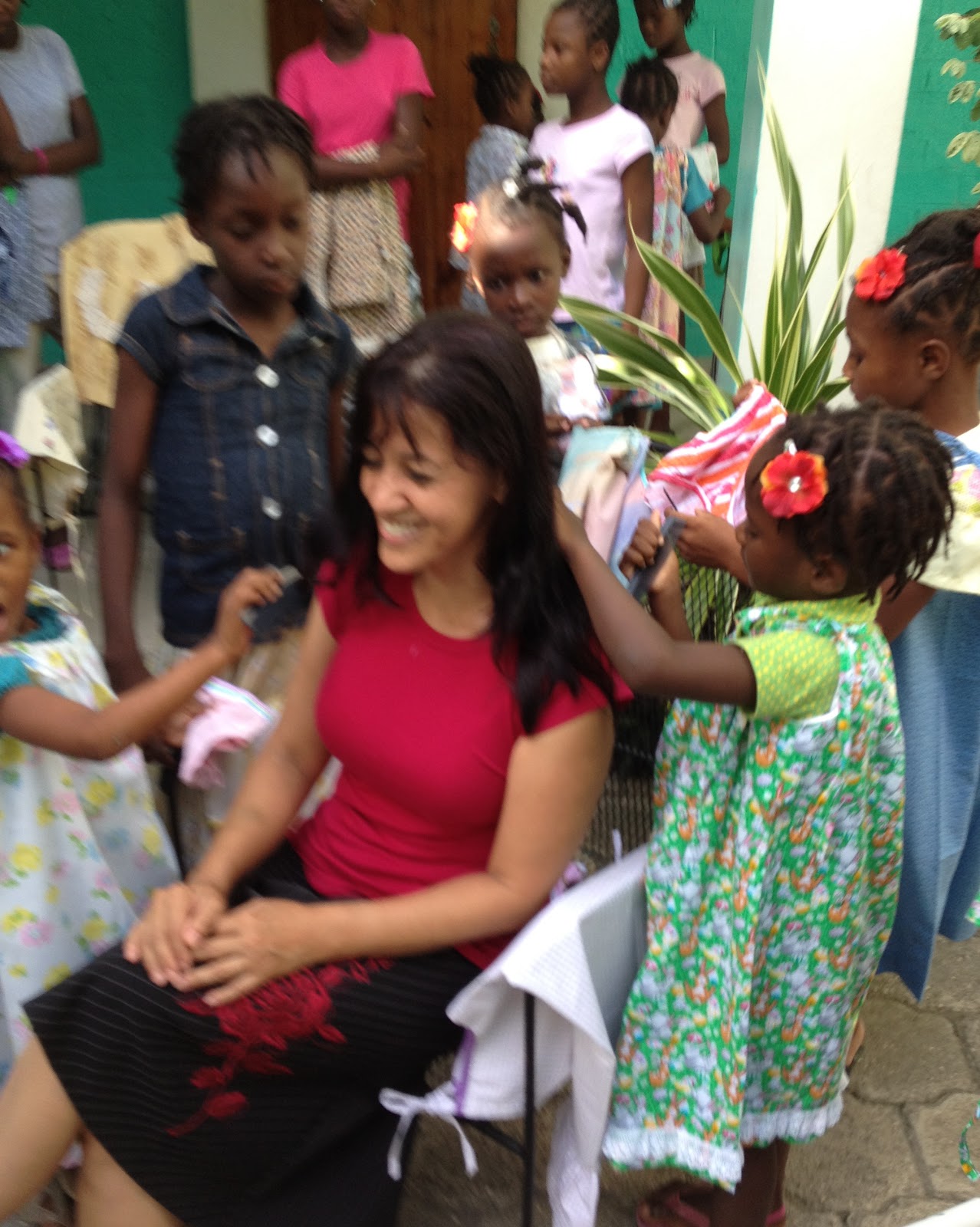
                                                   Moustafa is the girl on my left


What a heavenly feeling.  Right there, I experienced a unique exchange of love and fraternity.  We brought a donation in clothing and items for the kids, yet those little souls had nothing but pure love to give us in return.  Our spirits were filled with joy by their gracious and tender companion.  They were giving from their hearts. 


The following days were full of fun, extending our activities to the rest of the kids. Craft and drawing activities. 


But I was given another surprise.  As the younger boys were finishing a handprint shirt activity, I started to take pictures with my iPhone.  The kids wanted to see the pictures, and I showed them.  Then I set on the front-facing feature on my iPhone, attempting to take a picture of me with one of the kids.  As he saw his imagine on the screen, his eyes shone in awe, and he started to make facial gestures, then he giggled at his own imagine.  I turned on the video feature, and produced a quick video of him; his amazement was now greater.  This drew attention from the other kids, and within seconds, a crowd of kids were around me, wanting to be video-taped.  I made several quick videos and replayed them to the kids.  They just loved it!  They liked to see themselves. They were the stars on those videos.  Then they started to sing and dance while making more quick videos. Lots of fun!


A group of about 16 young men were involved in the village shores and helping to supervise the younger kids.  The group is part of a leadership project in which they will learn different skills to survive in the community.  Many of them came to the village at a very young age and may not know what to do when they go to the outside world: How to rent a room? How to enroll in college? How to find a job?  They also get spiritual guidance, being encouraged to be men with moral standards, and respect for others.  A few young men have been helped with grants to attend college. I heard for instance, of a young man who graduated as a physician, and has come back to the village to provide medical services. Another one graduated as an engineer. Every little effort counts. Each successful story is an example to the little ones who we prayed may have a better life than their parents. 


Over 2000 people are fed every day in the Hope Village: 600 plus kids from the orphanage, children from the communities around, and the village workers.  Espwa is the second largest employer in the town of Les Cayes. 


                                   ********************
We also spent time out of the village.  As part of our agenda, we visited the prison of Les Cayes, where over 500 people are incarcerated. First of all, it was a challenge to get authorization to visit the place, and bring packets with underwear and shirts for the inmates.  It had taken Fr. Marc and other people associated to Espaw, several years to build a relationship with the Chief Inspector and to allow visits and donations.  After 45 minutes or so of waiting, the Inspector arrived.  At first, we thought the Inspector was a military man in a highly decorated uniform driving a white vehicle.  But we quickly found out that man was a UN officer from Rwanda, and was there as part of the security that the UN peacekeepers provide to Haiti.  The actual Inspector came out of a heavily armored vehicle, with tinted windows and security glass. He was wearing a hawaiian shirt.  


We were finally allowed to enter the prison, in two groups. I was in the second group, so we patiently waited outside of the building.  When it was our turn, we walked into a courtyard surrounded by cells.  What we saw was shocking, even though we had been warned.  I have no words to describe the deplorable conditions of that facility and the misery reflected by the incarcerated men and women.  


There were about a dozen cells, each of 10 x 15 feet approximately.  In these cells were an average of 45 men. One cell had only 5 prisoners, who were isolated because of chicken pox.  Prisoners were reportedly allowed time in the courtyard once a day for a few minutes.  We observed men bathing in the courtyard, soapy water from a bucket.  Men wore only underwear.  I believed it was most likely because the heat would have been unbearable. 


The cells looked so crowded, men were clinging to the iron bars on the doorway, struggling for fresh air. I noticed a four-tiered bunk bed in each cell.  I wondered how they rotate turns to lay down. We heard the inmates receive only one meal a day. I spied a couple of guys eating some brown slop from a tin bowl, with their fingers. I had to fight back tears.


We handed out the packers with the assistance of an inmate assigned to help with this.  We were told how many men were in each cell, and that exact number of packets were handed through the cell opening to the “cell leader.”  It was interesting to learn about the informal hierarchy established within the cell.  As we went from cell to cell, we discreetly glanced at their faces, sensing a wide rage of emotions. Some were despondent, some smiled, some looked depressed, some looked angry.  A few expressed thankfulness.  We heard a couple of “Thank You”, in English.


The women seemed more fortunate than the men.  The 24 women, all in one cell fairly larger than the others, fared a bit better.  They were sitting and talking, and some were combing and braiding their hair.  We handed their packets to the cell leader, each containing washcloth, soap, sports bra and underwear. 


We concluded our visit by leaving enough packets for the prison workers.  We heard some of these inmates are guilty, some not, some have done more time than they could possible imagine for petty crimes.  Some have been incarcerated for months or even years without being formally charged or seen a judge.  There’s a heavy bureaucracy in Haiti, we learned. Not just in the penal system, but in every instance of the local government.


No doubt it was a dreadful place.  It was a disturbing scene what was in front of us.  Beyond punishment, what people faced right there was a spiritual breakage.  No one should have to suffer such inhumane conditions.  I pondered whether anyone would think being there was worse than the death penalty.  Physical suffering, emotional pain, and soul inertness were tested to the limit.  


I found out later that in 2010 there was a massacre that took place exactly in that prison. More than a dozen prisoners were killed and over 40 were wounded by the police. Read more here.


I was thankful for the opportunity to, at least, show those men and women that there are people out there thinking of them.  That there is hope even when one’s life seems reduced to mere misery and devastation.  That they were in someone’s prayers. 


                                 ***********************


By the next morning, I felt it would be a different day—a special day.  


That was the day to visit Mother Teresa’s orphanage, run by the Sisters of Charity. 


The place was gated and we were instructed that pictures were not allowed.  We met a sister from India who kindly started to show us the facility.  We initiated our tour with a unit with many babies, apparently under two years old, laying in cribs.  We were told those were sick and terminally-ill babies.  Many suffered of malnutrition, others had AIDS, or TB, etc.  Our hearts broke as we walked down the rows of cribs, and glanced at those little sad faces.  No smiles, no sounds of laughter, not even sounds of crying.  Only blank stares from the diminutive faces peering between the bars of the cribs.  


We learned that many of them wouldn’t make it. Heavy tears rolled down my face.  I glanced at my friends, and I felt a mild relief as I noticed I was not the only one bursting into tears.  The nurse told us it was okay to hold the babies, and we did.  The babies clung to our arms, and didn’t want to let go.  Then some began crying when placed back in the cribs. We discreetly wiped our tears away, and continued our tour, speechless.


We went upstairs to the floor for disabled kids.  It was a different panorama.  Happy faces, joyful voices and many laughters unfolded in front of us.  What a fresh air!  We met sister Guadalupe, an amazing and devoted woman with a heart of gold.  She spoke with passion, and emphasized about these kids being ‘the poorest of the poor,’ yet living a life with dignity, treated with respect and love.  There was no doubt about this statement based on what we observed.  We went through the different rooms and identified some of the kids diagnosis: Down Syndrome, Paraplegia, Quadriplegia, Blindness, Autism, Deafness, Mental Retardation, Amputations, etc.  Several kids were in wheelchairs.  The place was clean and harmonic.  It was obvious that there was an organized schedule of therapy exercises and classes, as well as a properly supervised routine of activities.  


Besides the sisters, Haitian ladies worked in the place as caregivers. Even though these women were not professional therapists, they had been taught exercises and skills to help the kids, by therapists that visited the place.  There is a Neurologist who comes to the orphanage once a year, and sees all of the disabled kids—over one hundred kids.  The kids are supplied with medical treatments and medications.  Sister Guadalupe mentioned that this doctor, who is from India, has been pleased with the kids improvement, stating: “Whoever your God is, He is here!”


We agreed.  The presence of God was there, and so the spirit of Mother Teresa, her philosophy of love and compassion to the poorest of the poor. That was a place of miracles. 


                                 ********************


We spent some more days in Les Cayes, enjoying time with the Espaw kids, and with people from the community. 


                                      ******************


 We left Haiti on July 6, but we brought with us an enlightening experience which we have shared with many others.  


I have kept in contact with some of the others that went to this mission trip, and we agree in two important facts: 


                  Our lives will never be the same.


                  Our Haiti mission has just started. 


How can you help? 
Sponsor one of these kids:
www.freethekids.org


Sunday, July 15, 2012

Haiti- The Pearl Of The Antilles (Part 1)


I’m reading about Haiti’s history, and I shake my head, trying to understand the problems the Haitians have faced for centuries.  As a child, I remember hearing people referring to Haiti as “The Pearl of the Antilles.”  A history where beauty and struggle collide.  A country earlier renowned for the splendor of its landscape, Haiti has faced fierce exploitation of natural resources by successive foreign occupations and predatory dictatorships.  Ongoing political instability has contributed to a sharp decline of agricultural productivity and widespread poverty.  Then, the destruction caused by the 2010 earthquake in which 316,000 people are estimated to have died.


Upon my arrival to Haiti, while observing the reality the Haitians face daily, I realized how little I knew about this country and its real challenges.  Embarked on a mission trip, along with nine other people, I felt embraced by the excitement of providing clothing and other supplies to children at Espwa, one of the largest orphanages in the world, located in the town of Les Cayes.  


I wanted to take part of that effort, even if my help seemed just like a grain of sand in an ocean of needs.  But a serendipitous discovery happened to me. The Haitian people we spent time with, the children we played with, the women and men we visited with, they all enlightened my heart with humbleness and compassion, they helped me to reflect on the eventual weakness of materialism and vanity.  When there’s no material objects, or luxury as a facade to others, that’s when the spirit of humanity shines, just like the summer sun.


Our arrival to Port-Au-Prince was thankfully uneventful. Transportation had been arranged, which was a tremendous help.  A couple of vehicles waited for us.  Our eyes were glued to the car windows, watching in awe during our five-hour ride from Port-Au-Prince to Les Cayes. 


It was a heartfelt tour through devastation and struggle, for miles and miles.  I’d be short on words if I tried to describe the scenes, and emotions.  Perhaps some pictures can illustrate better what we witnessed. 


Port-au-Prince has a population of about 1.2 million inhabitants and more than 2.5 to 3 million live in its metropolitan area, including the rapid growing slums on the hillsides above the city. 


The National Palace collapsed during the earthquake.  A once beautiful and glamourous building is now merely ruins. Fractured and frail--just like the country itself.  Here is a couple of pictures of the building, before and after the earthquake.


The streets were crowded with people walking up and down narrow streets. 

A lack of water supply and sanitation services were evident.  Most of the population don’t have tap water. Women and children carry buckets full of water daily.


Port-au-Prince is about the size of Chicago.  But it doesn't have a sewer system.  It's one of the largest cities in the world without one.  That's a huge problem, but never more so than during a time of cholera.  Since cholera was introduced into Haiti in the last two years, more than a half-million people have gotten sick and at least 7,050 have died. Public health authorities say cholera will stay in the environment for a long time, because Haiti has the worst sanitation in this hemisphere.


Trash piles up in Haiti’s ravines, canals and streets until hurricanes and heavy rains come, sweeping huge amounts of trash and thousands of plastic bottles out to sea.


One intervention to combat this problem is through recycling centers and cash payouts for recyclables brought in by local Haitians. The centers’ founders hope that financial incentives will encourage people to reduce the amount of garbage tossed aside as well as providing jobs and income for struggling families. 


Commerce in Haiti generally spills onto sidewalks, into streets and down avenues. Merchants establish wooden fruit and vegetable stands or take to selling wares from the ground or on foot.
The roads are bumpy and inconsistent, and the traffic is usually a chaotic flow of cars, trucks and motorcycles.  The most vibrant vehicles in Haiti are by far the the tap taps–privately owned buses festooned with flags and coated from bumper to bumper with vivid designs, murals and bold slogans.


As the country and the world look to rebuild Haiti, it’s important to understand the demographic dynamics facing the country, Haiti’s very young age structure. The median age of the population is 20 years, and almost 70 percent of Haiti’s people are under age 30. 
As we left Port-Au-Prince, going now into rural areas, the landscape changed to a more refreshing sightseeing.  From dreadful scenes we went to some awesome, breathtaking views.


Most of us remained quiet at this time. Not sure if it was our tiredness and fatigue catching up with us, or if we were deeply immersed in our thoughts, trying to comprehend what was in front of us.  In my case, I engaged in a profound reflection, as a social worker, as a human being, as a christian, and as a visitor.  My anxiousness grew stronger as we were approaching our destination: Les Cayes, where a world of further learning, emotions and loving would await for us.  We were about to spend one week in a Haitian community, meeting with hundreds of people--some of the most beautiful souls I've ever met.  I will tell you why Haiti stole my heart. 


Sunday, July 1, 2012

Destination Haiti: Guest Post


My guest post on our mission trip to Haiti, "Day Three," has been published over at the Schweitzer United Methodist Church website:


http://haiti.schweitzerumc.org/?p=255


Saturday, June 30, 2012

Destination Haiti


I inspected my small suitcase one more time. I had packed the most essential items for this particular trip. Unlike most of my recent vacation trips to the Caribbean, in this case I didn’t need to pack my hairdryer, or jewelry or an evening dress. That was the lightest traveling bag I’ve ever packed, considering I was going overseas. What made this trip so different from my prior ones? It was a mission trip. The Schweitzer United Methodist Church kindly let me join this project. We were a team of ten, our destination: Les Cayes, Haiti. 


                               Photo source: http://haiti.schweitzerumc.org/


We arrived at Port Au Prince on June 29. There was a group of men playing music at the airport entrance, and selling their CDs. I thought they were playing reggae, but I learned later it was actually “Kompa” which it sounds like a mix between reggae and rap. The music made me feel welcomed. 


The airport was small, and the humidity and heat were high, but it didn’t bother us. We were simply excited to know we have finally arrived to Haiti. Our energy level was at its peak.


The immigration process was not as difficult as we expected. It helped that our coordinator Lori was quite familiar with the process, as she has completed this trip multiple times. Everything went fast and without a hassle. The immigration officers seem to have some respect for visitors on humanitarian missions. They seem to appreciate all the baggages we carried containing hundreds of clothing and hygiene supplies. 


We dodged several “helpers” offering to carry our bags, as we had already made arrangements. A shuttle was waiting for us. It was comforting to feel the air conditioning again. It was much needed, as our real journey was just about to start.


Haiti, officially the Republic of Haiti, is a Caribbean country. It occupies the western, smaller portion of the island of Hispaniola, in the Greater Antillean archipelago, which it shares with the Dominican Republic.

Sunday, June 24, 2012

A Bridge to Betsy's World

                                                                                                        Photo Source


Betsy was in her own world.  A world we, on the outside, had little idea what was like for her on the inside, in her mind.

Aged in her nineties and diagnosed with end-stage dementia, Betsy’s daily routine in the nursing home was determined by what her caregivers anticipated her needs and wants may be on any given day. 


Betsy had lost her ability to communicate. Her dementia had stolen her words, and even her ability to make eye contact. The staff tried to keep her comfortable while she rested in her bed or her customized wheelchair. Betsy would look into space, sometimes moving her hands randomly, for no apparent reason. 


Betsy needed  assistance with her meals. I observed the aides patiently feeding her, spoonful by spoonful, with pureed food. 
  
I had visited with Betsy several times. I spoke to her, but she never responded, not even with her eyes. I tried sensory stimuli by applying lotion to her hands. I was uncertain if  she  enjoyed the stimulation, the gentile touching, at all. Perhaps I was simply an intruder in her private world.

My interest in Betsy grew stronger. I became more intrigued to bridge our two worlds.

Her family visited often. I was confident that Betsy could sense familiar voices and faces around her, and this would seem to please her. But again, Betsy’s cognitive impairment was so profound that she may have not known who was around. Nonetheless, the family was content with being there for her. They felt it was the right thing to do. And as their social worker, I assured them that was indeed the right thing to do!

“What is Betsy passionate about?” I asked Julie, Betsy’s daughter, during one of her visits. 

“Mother played the piano.” 

“I know she played the piano at church,” I recalled from my social services assessment. “Tell me more.”

“Mother’s interest in the piano comes from her childhood. My grandmother taught her to play the piano,” Julie said, proudly. “My grandmother loved classical music, and so Mother.”

“Did your Mom play the piano throughout her life?”

“That was her life!” Julie exclaimed. “She played at home, at church. She even taught piano lessons for a while.”

Julie had brought a radio to her mother’s room. It was normally tuned to a classical music station. I had no doubt Betsy liked to hear the music. But again, there was no indication of Betsy’s level of enjoyment other than her being calm. 

I continued observing Betsy. I pondered Julie’s statement about her life-long interest in the piano. I realized that Betsy and I had at least one thing in common—we both loved classical music. 

One day, as I was leafing through my CD collection, I came across my favorite classical music pianist: Chopin. Nocturnes were my preferred.  As I mused how divine Chopin’s Nocturnes were to my ears, an idea flashed in my mind. 

Betsy may like Chopin too. 

I brought a CD player and my Chopin’s Nocturnes album to Betsy’s room. She lay in bed, looking aimlessly above her, expressionless, moving her hands randomly, as usual. I plugged in the CD player, and pressed the “play” button.


As the music started to fill the air, she slightly moved her head toward the music coming from the CD player. She seemed calmer, but still expressionless. Another idea came to my mind. I gently reached for Betsy’s hands. I gently started tapping my finger tips against hers in measured time to the piano notes. 

Then something amazing happened.

Betsy’s fingers started dancing upon my hands as if she were playing the piano.


Excitement embraced me. I had somehow connected to Betsy in her world. I knew she was listening and enjoying the music. I knew she was feeling my touch. I knew her tactile memory had not vanished, despite her detrimental Alzheimer’s. 

Betsy, the pianist and classical music lover, was still alive, vibrant. I felt like I uncovered a radiant Betsy from under the facade of an elderly incapacitated lady. I had nothing but respect and admiration for the loving mother, compassionate church fellow, and pianist which lay before me.

And from that day on, Betsy was no longer lost in her own world. We had discovered a language to reach to the treasures in her mind—the language of music.